R&D Focus
Green Glass Adsorbent Technology Combats Toxicity
Video of Green Glass Adsorbent Technology.
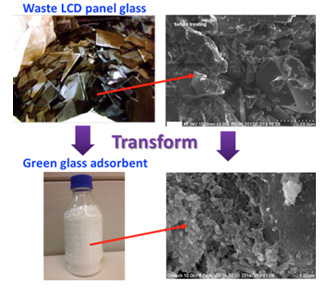
ITRI’s Green Glass Adsorbent, transformed from waste LCD panel glass, is highly efficient in treating wastewater containing heavy metals.
Industrial wastes, if not properly treated, may cause heavy metal contamination of soil and water. Once discharged into the environment, these heavy metals will pose severe ecological and health hazards. Adopting a circular economy approach, ITRI developed the Green Glass Adsorbent Technology for wastewater treatment, a highly efficient heavy metal adsorbent created by the transformation of waste LCD panel glass. This reuse approach and the new type glass-based metal adsorbent are both the world’s first application of these techniques.
Waste LCD panel glass is a kind of alkaline earth boro-aluminosilicate with stable composition and high purity. ITRI applied a unique technique to transform it into a novel type of heavy metal adsorbent, increasing its reuse value significantly. The production process involves crushing, extraction, blending, purification, reusing, leaching, concentration, and transformation, as illustrated in the following chart.
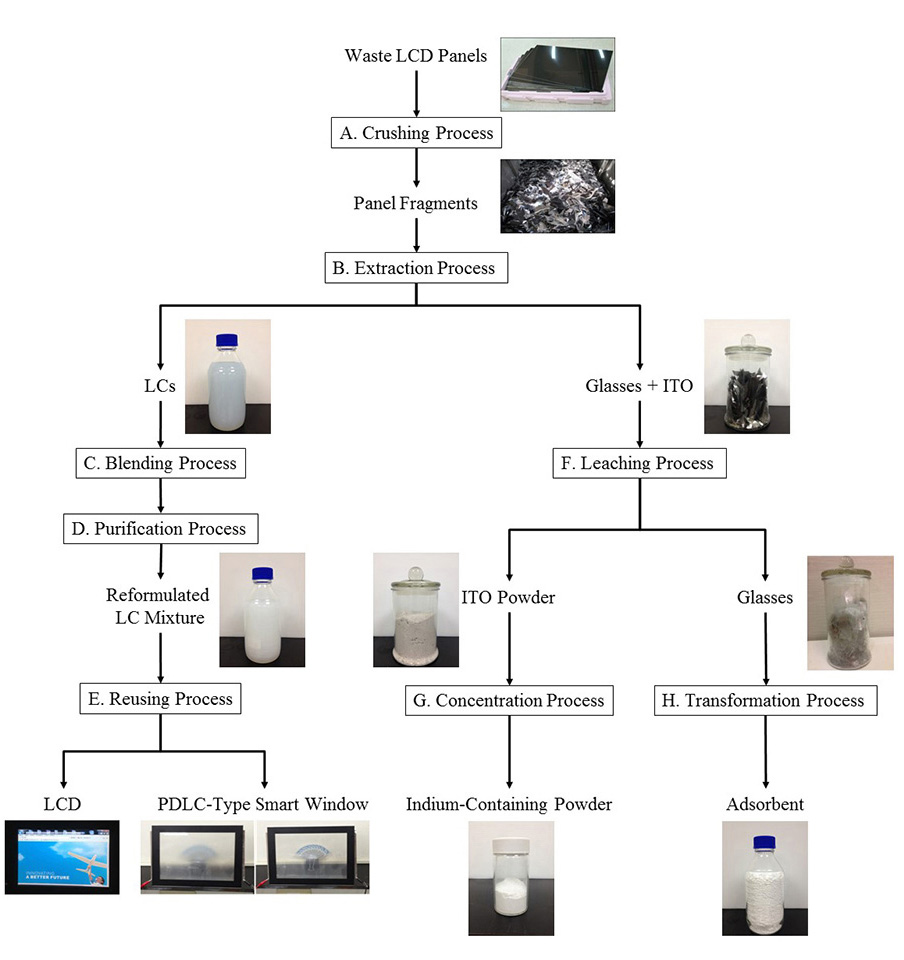
Production Process of ITRI’s Green Glass Adsorbent.
With ITRI’s patented transformation process, the modified glass is characterized by its highly microporous structure (with pore diameter of 10 nm), large surface area (>180 m2/g), and more asymmetric charges and reactive sites for ion exchange. Since the glass structure is retained on purpose during the transformation process, the Green Glass Adsorbent has high resistance against acids and chemicals and can even be used to treat wastewater with a low pH value (equating to 0). Thus it has wider application than currently used metal ion adsorbents or ion exchange resins.
The Green Glass Adsorbent exhibits high adsorption capacity (see table below). It has been used to treat wastewater containing >500 ppm concentration of Cu, Ni, Cr, Zn with an on-line modularized system for several electroplating plants (producing 200 tons of wastewater per day) in central Taiwan. Adsorbed metal ions can be simply desorbed, concentrated and further recycled, whereas the Green Glass Adsorbent can be regenerated and re-used more than 20 times. No secondary pollution is generated after the adsorption process. Furthermore, the treatment application is simple; the adsorbent is added directly into wastewater to adsorb heavy metals without pretreatment. More importantly, it has lower production and operation costs as this adsorbent is transformed from waste LCD panel glass.
Langmuir Model
| qmax | Kd(L/mg) | R2 | |
|---|---|---|---|
| Pb | 135.10 | 0.039 | 0.9940 |
| Cu | 68.50 | 0.330 | 0.9909 |
| Cd | 59.90 | 0.018 | 0.9942 |
| Zn | 114.90 | 0.013 | 0.9917 |
| Cr | 65.80 | 0.008 | 0.9909 |
| Ni | 49.00 | 0.014 | 0.9928 |
The Maximum Adsorption Capacities of Each Heavy Metal Ion.
ITRI’s Green Glass Adsorbent Technology is a simple, low-cost wastewater treatment system that can ease downstream processing, increase production yields, and has proven scalability. It is suitable for industries associated with electroplating or LCD, semiconductor, LED, and PCB manufacturing. While addressing wastewater treatment, it also offers an ideal solution to waste LCD panel disposal. The approach not only achieves economic and environmental benefits, but exemplifies a “cradle to cradle” model in sustainable waste and resource management.