Collaboration
MOU Inked by ITRI and Thailand’s NSTDA
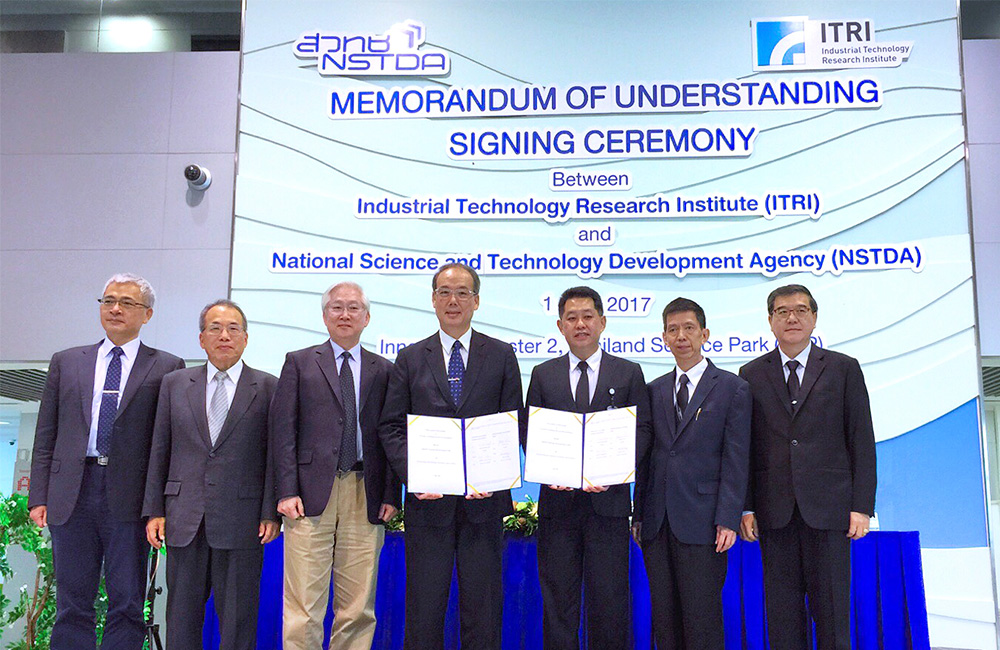
The MOU signing ceremony between ITRI and NSTDA took place in Thailand on June 1, 2017.
ITRI Chairman Dr. Tsung-Tsong Wu led a delegation in signing a memorandum of understanding (MOU) on cooperation with Thailand’s National Science and Technology Development Agency (NSTDA). On June 1, Chairman Wu and Thailand’s Ministry of Science and Technology Vice Minister Dr. Pornchai Tarkulwaranont witnessed the signing of the MOU by ITRI President Dr. Jonq-Min Liu and Executive Vice President Dr. Pei-Zen Chang, and NSTDA President Dr. Narong Sirilertworakul and Executive Vice President Dr. Werasak Udomkichdecha. The MOU is expected to unite each organization’s strengths in developing innovative applications and pave the way for Taiwan companies to participate in Thailand’s Eastern Economic Corridor (EEC) project. This effort also echoes the government’s New Southbound Policy, which encourages cooperation with 18 countries in ASEAN, South Asia, and Australasia.
Thailand as of late has promoted a large-scale economic reform plan called Thailand 4.0, with the strategy focusing on the digital, biotech, and innovation economy. The most important part of this policy initiative is the promotion of the EEC, which will be realized at a cost of 1.5 trillion Thai baht (US$43.83 billion). The goal is to turn the eastern part of Thailand into the most advanced economic development center in ASEAN, and for it to be a hub and corridor from which Thai products will enter Myanmar and Cambodia. ITRI Chairman Wu believes that Thailand’s current plan for integration of the supply chain for small- and medium-sized enterprises, along with enormous opportunities for entry into the Thai, Myanmar, and Cambodian markets, corresponds to the government’s New Southbound Policy. This thereby creates a mutually beneficial cooperation model and an ideal opportunity for economic and trade cooperation, manpower interaction, and the sharing of resources.
ITRI and the NSTDA are considered the most important science and technology R&D organizations in Taiwan and Thailand, respectively. In the future, the two will support each other with their respective R&D expertise and serve as intermediaries in assisting the governments of each side and tapping into the needs of the private sector, while closely monitoring technological development trends. Future cooperation and interaction between the two organizations will create an innovation-oriented industrial value chain.