Collaboration
Bringing Water Into the Loop ITRI–ZYRQ Immersion Cooling for Data Centers
To address the escalating cooling demands of power-hungry AI chips, ITRI has partnered with ZYRQ, a Japanese startup spun off from supercomputer processor developer PEZY Computing, to develop a water-based immersion cooling technology. The solution is designed to sustain high chip performance while significantly improving energy efficiency and environmental sustainability.
Why Water, Not Oil?
Unlike conventional immersion cooling systems that rely on oils or fluorinated liquids, this technology uses water as its primary cooling medium. Building on PEZY Computing’s prior research in liquid immersion cooling, ZYRQ and ITRI developed a water-based solution that is non-toxic, recyclable, and offers zero-carbon potential. “Water is pollution-free and can be fully reused,” said Bing-Shiang Yang, Deputy General Director of ITRI’s Mechanical and Mechatronics Systems Research Laboratories (MMSL). “This partnership demonstrates how computing performance can be maximized while reducing electricity consumption.”

ZYRQ President Nagai Masaru (left) and Dr. Bing-Shiang Yang, Deputy General Director of ITRI’s MMSL (right) mark a new partnership on water-based immersion cooling.
Designing for Efficiency
Energy efficiency is further enhanced through ITRI’s contributions in thermal component design, fluid formulation, and system integration. These innovations substantially reduce the power required for heat dissipation, enabling data centers to deliver more computing power with less energy. As a result, operators can lower both operational costs and carbon emissions while reducing dependence on large-scale cooling infrastructure.
Lighter, Smarter Hardware
ITRI also applied its expertise in metal 3D printing to manufacture lightweight cooling plates that reduce copper usage. This not only improves overall system energy efficiency but also increases deployment flexibility by lowering equipment weight.
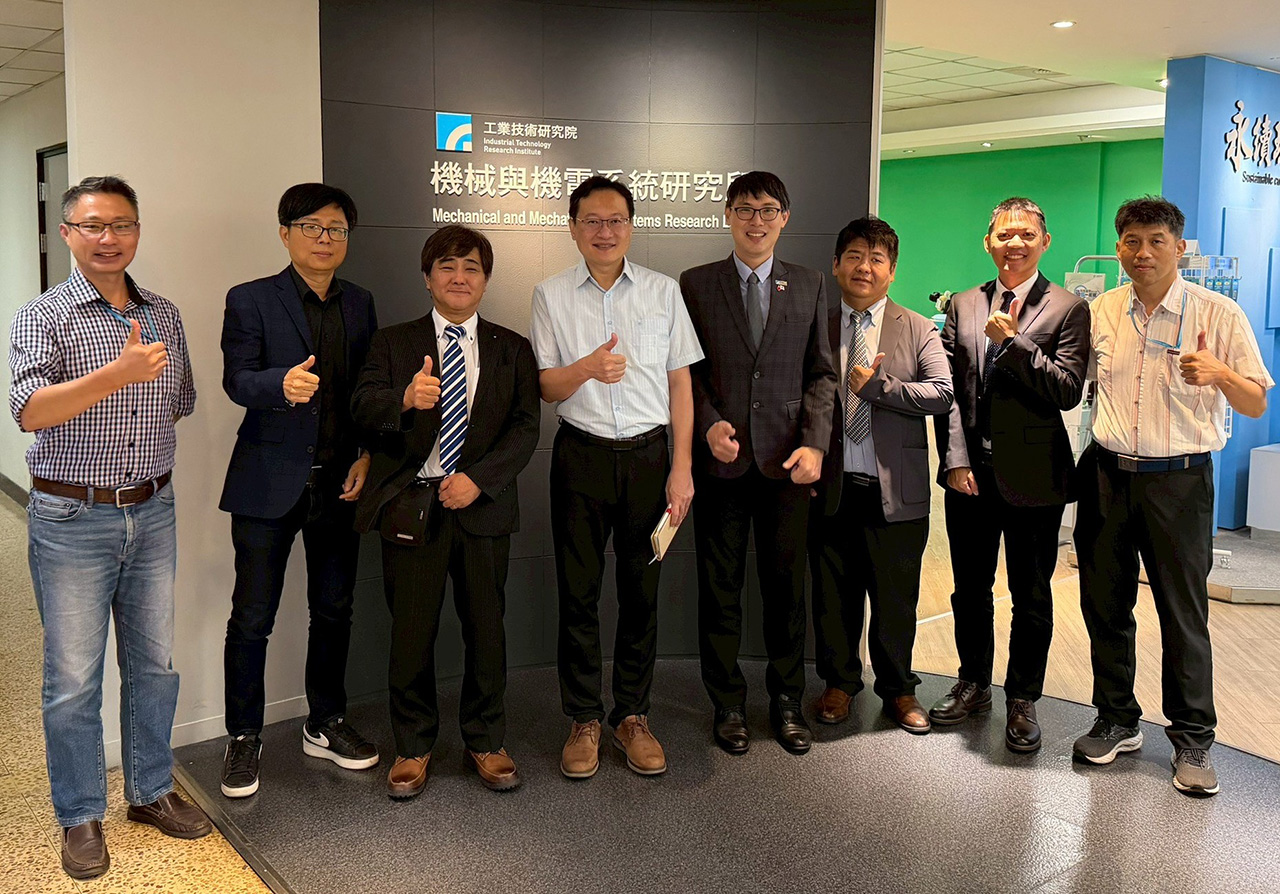
ZYRQ President Nagai Masaru (third from left) poses with ITRI’s MMSL team members.
Performance Results Proven
The technology’s performance was validated through three joint tests conducted in Japan. Results showed that GPU surface temperatures were maintained below 30°C while supporting power densities of up to 200 kW per cubic meter. The system retained 99.9% of chip computing performance, achieved a power usage effectiveness (PUE) as low as 1.015, and delivered cooling efficiency roughly twice that of conventional liquid cooling systems. Its streamlined design also reduces installation costs significantly.
What Comes Next
With strong footholds in Japan’s high-performance computing (HPC) market and advanced system integration capabilities, ZYRQ serves as a key strategic partner for introducing Taiwan-developed technologies into Japan’s semiconductor supply chain. The water-based immersion cooling solution addresses critical cooling needs in regions such as Kyushu while supporting data center deployment and expansion worldwide. Looking ahead, this partnership could accelerate the miniaturization and decentralization of data centers, helping establish a new paradigm for sustainable computing in the AI era.