Activity
2026 VLSI TSA: Quantum, AI, and Smart Healthcare
From wafer-scale AI chips to emerging quantum architectures, the future of computing took center stage in Hsinchu, Taiwan. The 2026 International Symposium on VLSI Technology, Systems and Applications (VLSI TSA), hosted by ITRI, recently concluded, bringing together more than 800 experts from around the world. Now in its 43rd year, the symposium continues to serve as a leading global forum for semiconductor innovation.
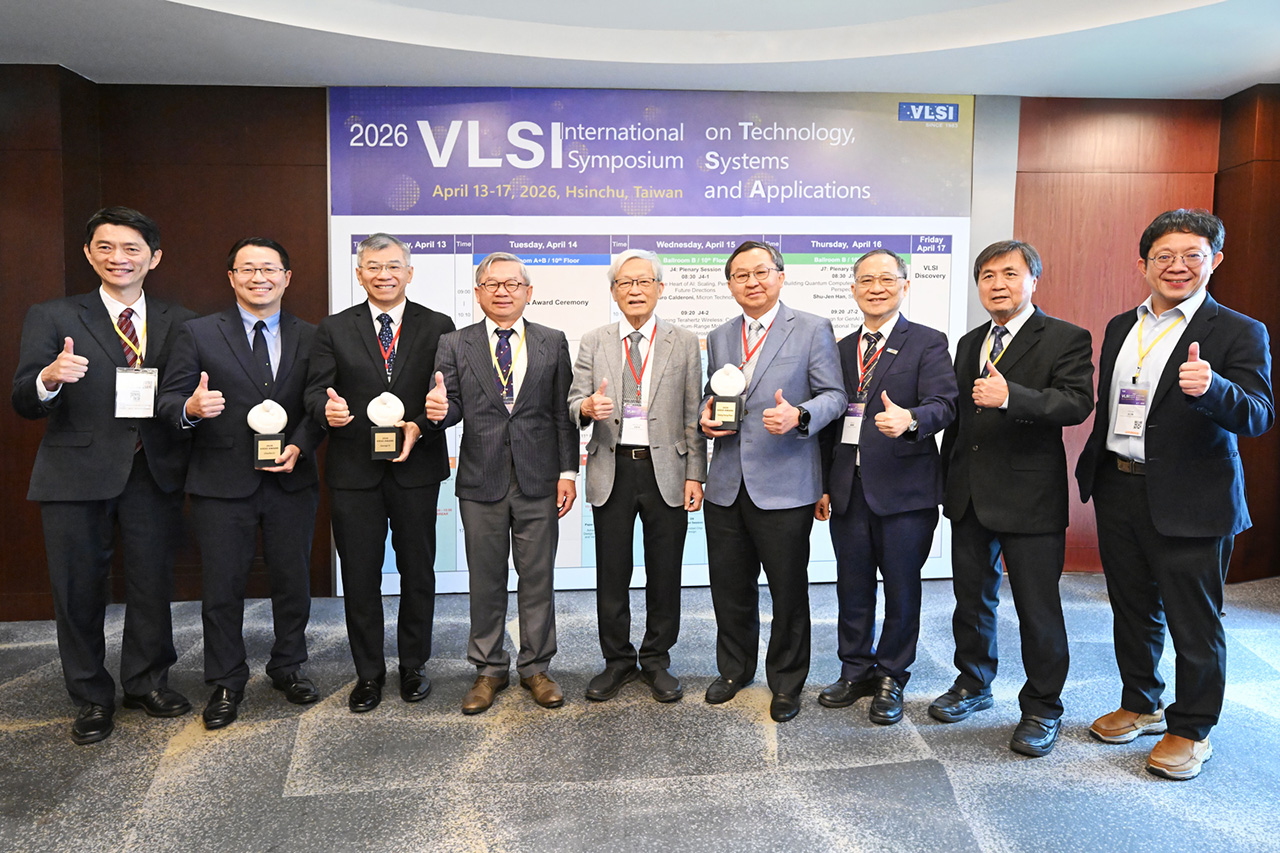
Industry leaders and academic experts gather at the 2026 VLSI TSA to exchange insights on emerging semiconductor technologies.
This year’s program highlighted key technology frontiers including generative AI inference acceleration, wafer-scale computing, and terahertz (THz) wireless communications. Leading the plenary sessions, Bendik Kleveland, Distinguished Engineer at Cerebras Systems, outlined the evolution of wafer-scale technology. The event also introduced its first dedicated exploration of quantum computing architectures and highlighted the growing role of semiconductors in smart healthcare, particularly AI-enabled cardiac rhythm analysis.
“This year, we focus on advanced process technologies, heterogeneous integration, AI and quantum architectures, next-generation memory, and advanced packaging—all key to enhancing AI chip performance and semiconductor innovation,” said Shih-Chieh Chang, Vice President and General Director of ITRI’s Electronic and Optoelectronic System Research Laboratories, who served as Chairman of the 2026 VLSI TSA. “Amid evolving global trade dynamics, Taiwan must strengthen frontier R&D, advance localization of equipment and materials, and build resilient supply chains through regional collaboration, trusted partnerships, and transparent governance, while deepening international academia-industry cooperation to cultivate talent and sustain global leadership,” he noted.
The symposium opened with a deep dive into transformative applications at the intersection of AI and healthcare. Professor Shih-Ann Chen of National Yang Ming Chiao Tung University and Taipei Veterans General Hospital explained that the complexity of cardiac rhythms cannot be fully captured by surface electrocardiogram (ECG) measurements alone. He demonstrated how electrophysiologic testing provides detailed intracardiac signal data, enabling AI models to improve predictive accuracy and enhance clinical diagnostics.
Memory technology was another focal point. Alessandro Calderoni, Fellow at Micron Technology, noted that logic throughput is scaling far faster than memory bandwidth, necessitating advanced 3D integration and heterogeneous packaging to enable high-bandwidth memory solutions to deliver substantial performance gains and superior energy efficiency. As DRAM scaling approaches atomic limits, he emphasized that breakthroughs in process control, sensing, and reliability will be critical to sustaining high-performance semiconductor computing capacity.
In next-generation communications, Professor Minoru Fujishima of Hiroshima University presented new possibilities for THz technologies. Drawing inspiration from optical satellite communication systems, he proposed leveraging the 300 GHz wideband and electronically steerable phased arrays to enable high-data-rate mobile connectivity over medium ranges, bringing ultra-fast wireless applications closer to reality.
Looking ahead to the future of computation, Shu-Jen Han, CTO of SEEQC, outlined a roadmap toward utility-scale quantum systems. He emphasized that realizing practical quantum computers will depend on advances in quantum error correction and scalable system design, providing a blueprint for next-generation computing architectures.
The symposium also presented the ERSO Award to George Yi, Shang-Hung Shen, and Charles Lee for their contributions to Taiwan’s high-tech industries. The Chenming Hu Award, sponsored by Chenming Hu of University of California, Berkeley, recognized Ming-Hua Tsai and Juin-Ming Lu for advances in semiconductor innovation.