R&D Focus
Robots in the Coop Automating Poultry House Monitoring
Inside a commercial poultry house, farmers typically make two to four rounds a day to check flock health, litter conditions, and signs of disease. These inspections are essential for catching problems early, but each entry increases biosecurity risks, as pathogens can be carried in on clothing or equipment.
To reduce human exposure while maintaining continuous oversight, ITRI partnered with Taiwan’s Livestock Research Institute to develop a robotic poultry house inspection system for automated environmental and health monitoring.
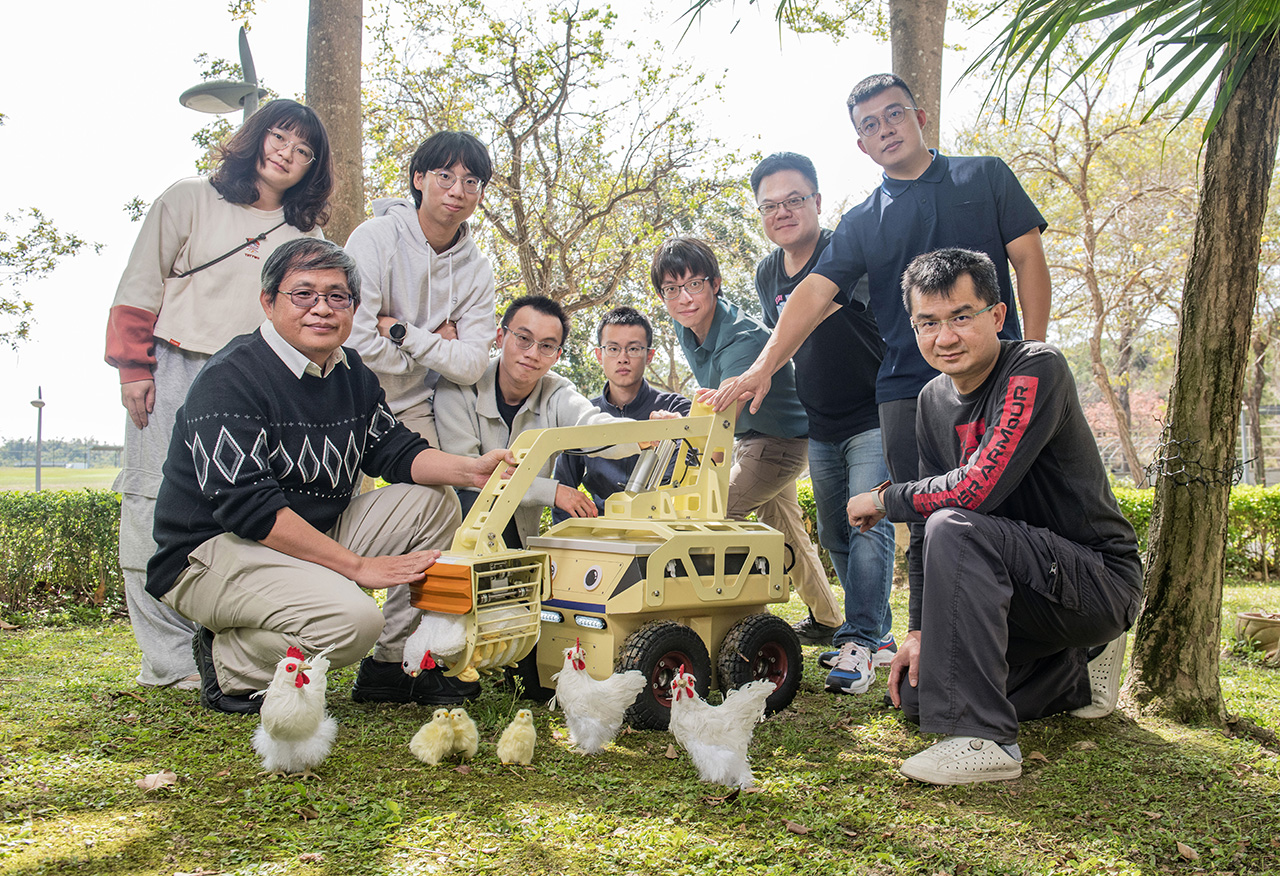
Researchers pose with the autonomous mobile robot developed for poultry house inspection.
“Poultry houses are difficult environments for automated systems,” said Wen-Ching Ko, Deputy Division Director at ITRI’s Central Region Campus. “Dust, feces, humidity, and constant animal movement make reliable sensing challenging, which is why we designed the platform to combine multiple sensing methods.”
A Dual-Robot Architecture for Comprehensive Monitoring
To improve visibility inside poultry houses, the system combines two complementary robotic platforms that monitor from different perspectives.
An overhead hoist transport vehicle travels along rails above the coop, providing a bird’s-eye view of flock activity. On the ground, an autonomous mobile robot patrols the floor to inspect details hidden from above, such as litter conditions and individual birds.
Together, the two robots form a distributed sensing platform that enables continuous monitoring and earlier detection of potential problems.
The ground robot navigates autonomously using multi-sensor fusion that integrates LiDAR, RGB-D cameras, and infrared sensors for obstacle detection and route planning, achieving positioning accuracy within ±10 cm.
Beyond navigation, the system continuously monitors poultry health using RGB-IR sensors and thermal imaging. Because thermal sensing does not rely on visible light, monitoring can continue in daylight, darkness, and the low-visibility conditions common inside poultry houses.
One of the system’s primary functions is detecting early signs of disease before visible symptoms appear. Chung-Li Tai, Deputy Division Director at ITRI’s Smart Sensing & Systems Technology Center, noted that in commercial poultry farming, health issues can spread rapidly through an entire flock if not identified early. “Even a 0.5°C change in a chicken’s body temperature can signal the early onset of health problems,” he said.
By combining overhead behavioral monitoring with close-range thermal inspection, the system enables comprehensive flock assessment with minimal human intervention.
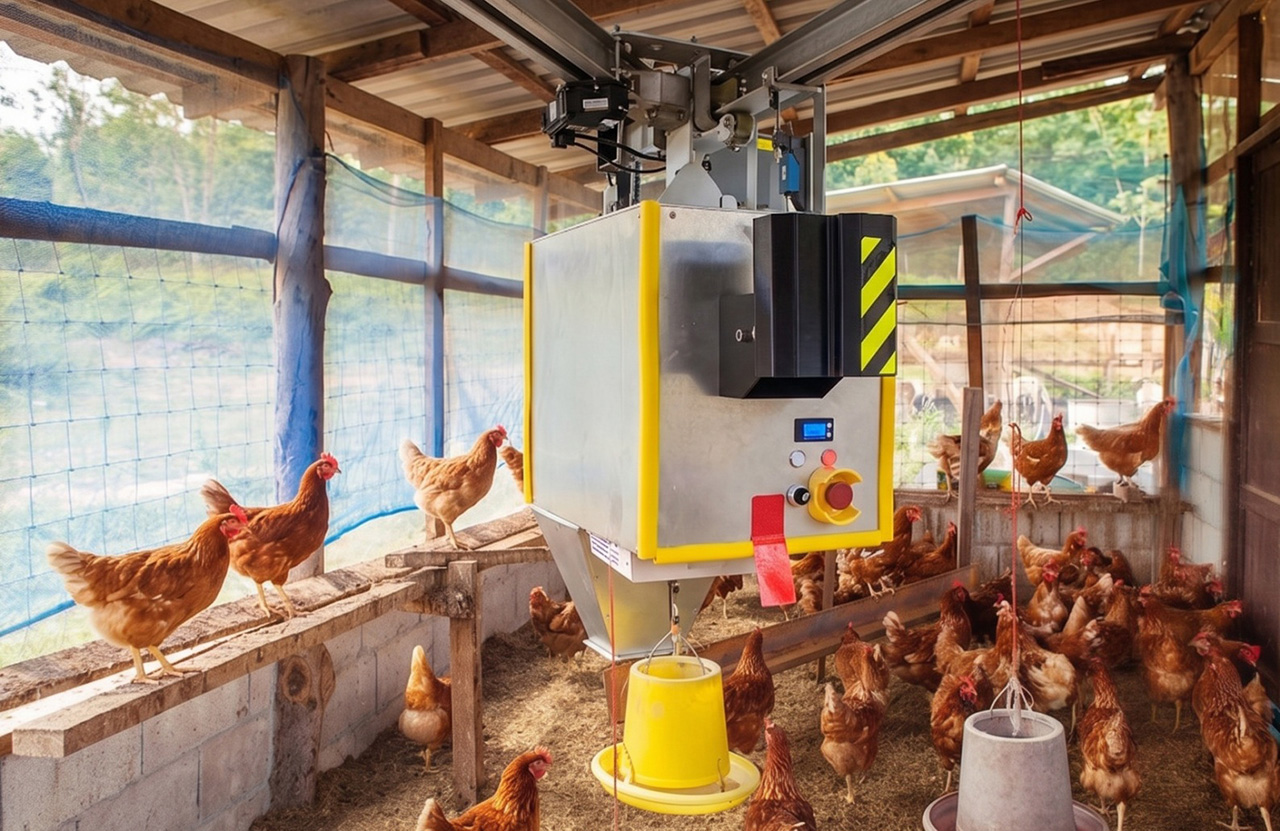
Simulation image of the overhead monitoring vehicle used for flock behavior and thermal sensing
Automating Routine Coop Maintenance
In addition to monitoring, the ground robot supports daily coop maintenance tasks that improve hygiene and biosecurity.
One key function is litter management. Poultry bedding materials such as wood shavings and rice husks must be regularly turned to prevent ammonia buildup that can irritate birds’ respiratory systems. As the robot patrols the coop, it automatically turns the bedding to maintain aeration and improve environmental conditions.
The robot also assists with carcass management. Equipped with a mechanical arm capable of handling loads of up to 3 kg, it can locate and remove dead birds from the coop. Rapid removal reduces contamination time and lowers the risk of cross-infection.
Toward Data-Driven Livestock Management
By automating inspection and maintenance tasks, the system gives farmers continuous visibility into coop conditions without repeated human entry, replacing periodic manual rounds with real-time monitoring data and early warnings of environmental changes or potential disease outbreaks.
As poultry farms scale and biosecurity standards become more stringent, robotic inspection systems like this could accelerate the shift toward data-driven livestock management, improving animal welfare while reducing labor demands and operational risk.