Feature
Semicon Network Summit 2026 Global Chip Collaboration in the AI Era
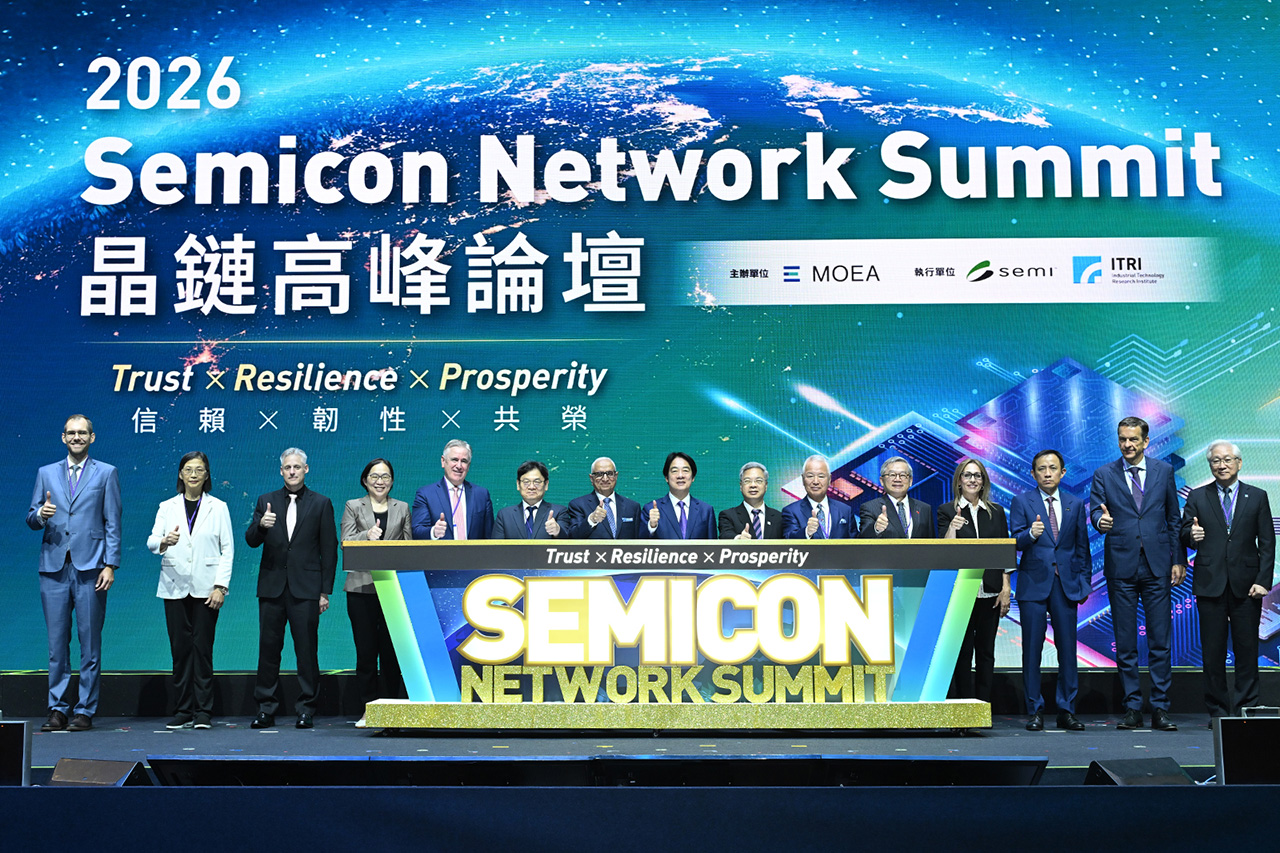
Government officials and industry leaders worldwide gather at the summit to explore semiconductor supply chain opportunities in the AI era.
Taiwan’s Ministry of Economic Affairs (MOEA) hosted the Semicon Network Summit 2026: Trust, Resilience, and Prosperity in Taipei on September 1, jointly organized by ITRI and SEMI. More than 600 government officials, industry leaders, and research experts from around the world gathered to explore new opportunities for the semiconductor ecosystem in the AI era.
Recognizing Industry Contributions
The summit also recognized two industry leaders for their contributions to Taiwan and the global semiconductor industry. Taiwan President Lai Ching-te attended the summit and presented the Medal of Economic Contribution to Doris Hsu, Chairperson and CEO of Sino-American Silicon Products and GlobalWafers, for strengthening Taiwan’s role in the global semiconductor materials supply chain, and to Sanjay Mehrotra, President and CEO of Micron Technology, for advancing U.S.–Taiwan semiconductor cooperation.
Global Voices at the Summit
The event drew participants from 38 countries. Notable representatives included Bill Frauenhofer, Executive Director for Semiconductor Innovation and Investment at the U.S. Department of Commerce; Akira Amari, Honorary Chair of Liberal Democratic Party Semiconductor Strategy Caucus; Kilian Gross, Director for Enabling and Emerging Technologies at DG CNECT, European Commission; Michał Jaros, Secretary of State at Poland’s Ministry of Economic Development and Technology; and Ariel T. Sobelman, Head of Advanced Computing at Israel’s National AI Directorate within the Prime Minister’s Office.
Four Priorities for the AI Era
“This year’s summit builds on last year’s discussions on strengthening the semiconductor supply chain through international partnerships, with a focus on four key areas: advanced technologies and materials, cross-border collaboration in silicon photonics, chips for AI robotics, and semiconductor cybersecurity resilience,” said Taiwan Minister of Economic Affairs Ming-Hsin Kung.
Building Resilient Global Connections
In prerecorded video remarks, Jacob Helberg, U.S. Under Secretary of State for Economic Affairs, called on partner economies to keep investing and building strong, resilient connections, emphasizing that the U.S. and Taiwan are partners in securing the technology that will shape the rest of this century.
“Taiwan’s comprehensive semiconductor ecosystem makes it a key partner in the global semiconductor industry, while the industry’s highly globalized nature calls for international collaboration to strengthen supply chains,” said Ajit Manocha, President and CEO of SEMI. “We appreciate the MOEA for bringing governments, industry, and global partners together for this important dialogue. SEMI will continue to deepen these connections and foster a more resilient industry.”
The summit’s four panel discussions addressed key priorities for the next phase of the semiconductor industry, focusing on trusted global partnerships, the silicon photonics ecosystem, next-generation chip trends in AI robotics, and cyber resilience across the supply chain.