Feature
Building Quadruped Robots for Different Missions
A quadruped robot carrying sensors into a fire scene faces different demands from one inspecting a narrow underground utility tunnel. Different payloads, dimensions, sensors, and operating conditions call for different machines. ITRI’s answer is an open R&D platform for configuring and testing quadruped robots around specific mission requirements.
Building Around the Job
The platform allows sensors, motors, body size, and other hardware and functions to be adjusted for different applications, then integrated and tested as a complete system.
For component suppliers, that creates a testbed for requirements that may only become clear at the system level. A motor designed for conventional industrial machinery, for example, may be subjected to repeated impacts and changing loads with every step when used in a quadruped robot. By testing components on a complete robot, suppliers can see how they perform in actual applications, refine their specifications, and apply those lessons to future products.
To bring those components together into working machines, ITRI acts as both a technology developer and a platform integrator, coordinating technologies from more than 20 Taiwanese companies across key components, manufacturing, and systems. The result is not a single standard robot, but two designs developed around very different operating requirements.
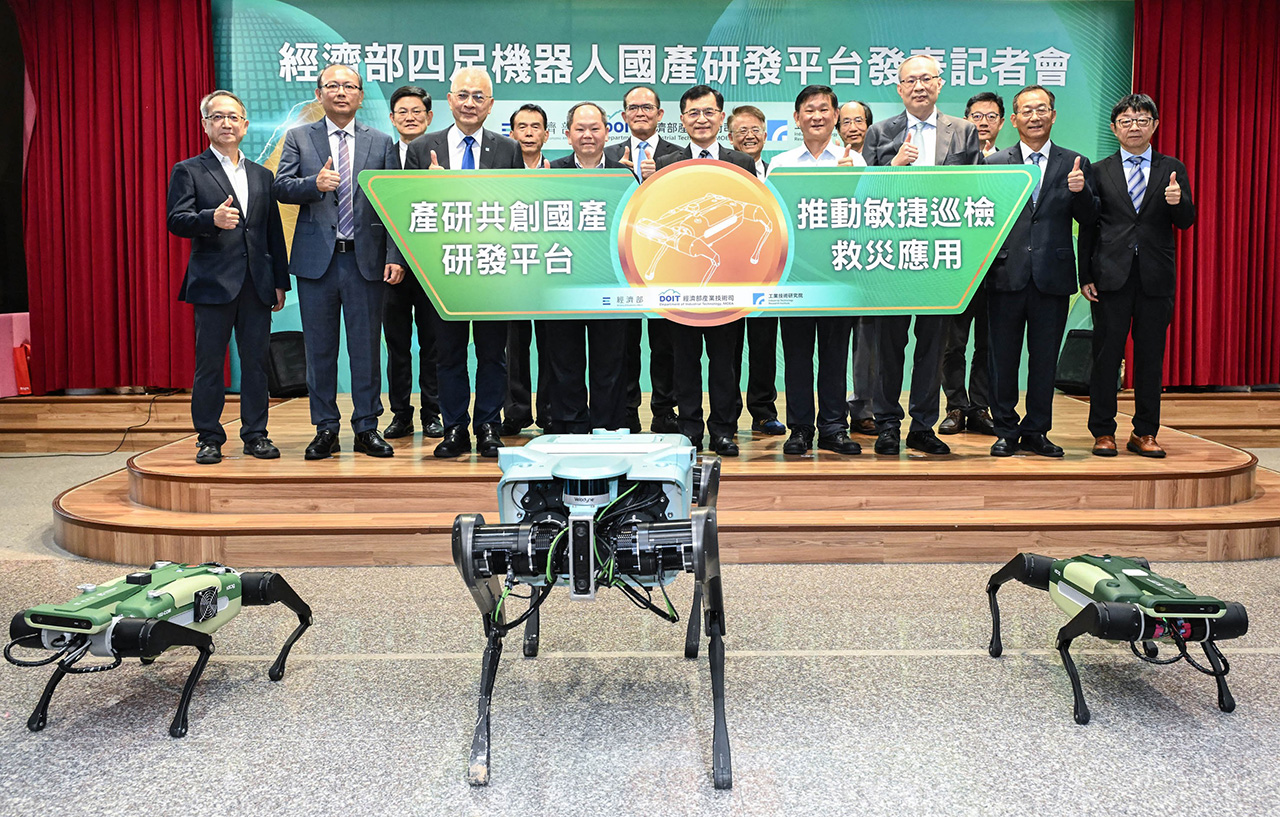
Representatives from the MOEA, ITRI, and industry partners present ITRI’s quadruped robot R&D platform alongside its larger and smaller robot designs.
One for Fires, One for Tunnels
The platform has produced two main designs, each built around a different job.
The larger quadruped robot targets firefighting and search-and-rescue assistance, where its roughly 20-kilogram payload capacity allows it to carry multiple sensing systems. In a smoke-filled fire scene, it can switch between visible-light and thermal imaging to locate fire sources and people, while LiDAR maps the unfamiliar interior as it moves. Sensors monitor seven hazardous gases, temperature, and humidity, providing data for AI to assess the risk of flashover or explosion.
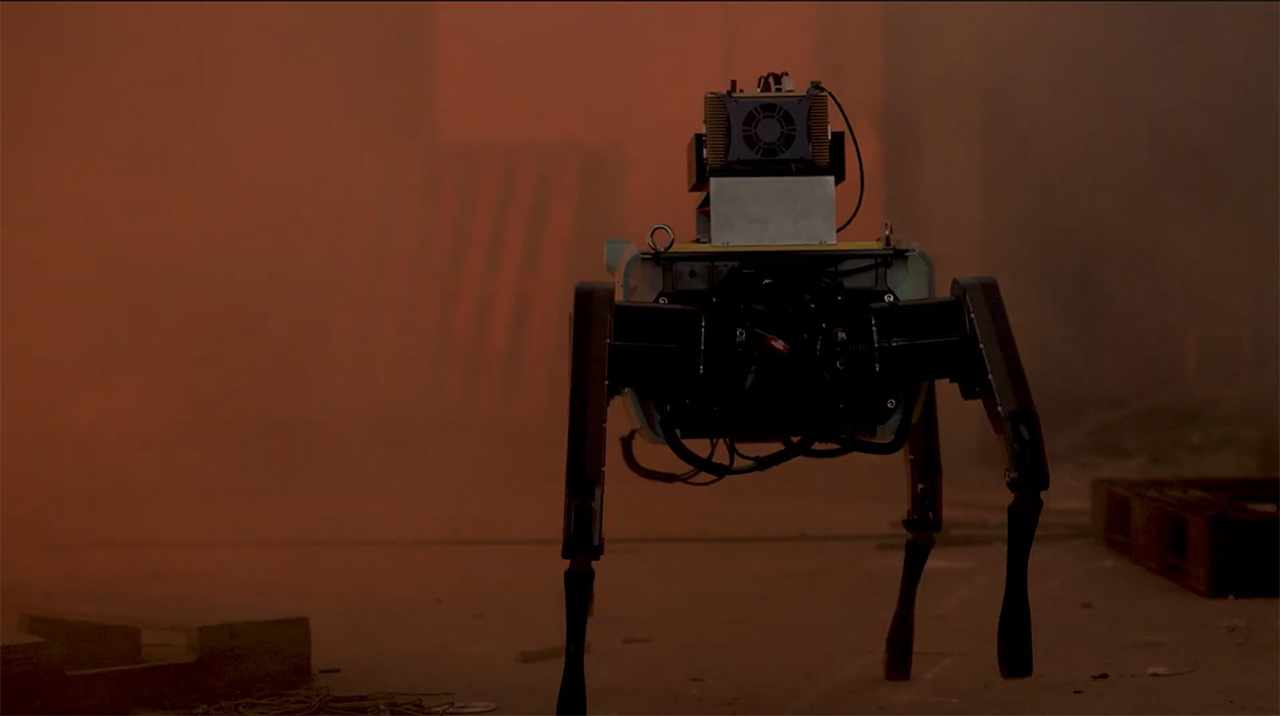
The larger quadruped robot conducts a reconnaissance mission in a simulated fire scene.
The smaller robot is designed for equipment inspection in narrow underground utility tunnels, where inspection routes may extend up to 1 kilometer. Its compact body can climb stairs, crawl through low-clearance areas, inspect equipment, and read instruments. In laboratory testing, its speed reached 2 meters per second. It can also carry ultrasonic sensors to detect high-pressure gas leaks at frequencies beyond human hearing, use vision systems to read gauges, and detect unusual odors.
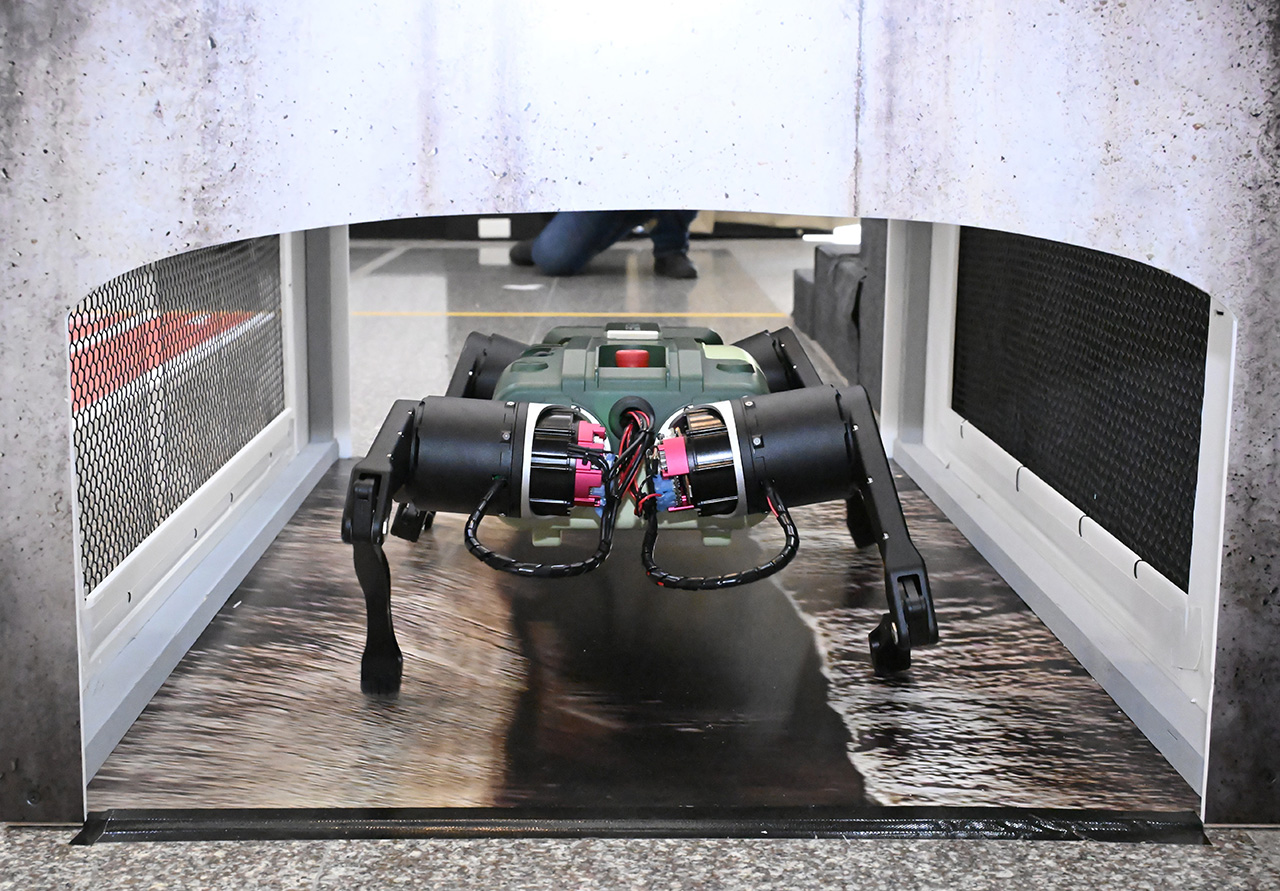
The smaller quadruped robot crawls through a narrow underground utility tunnel model designed to test its mobility in confined spaces.
Proving It Beyond the Lab
In a simulated fire environment, the larger quadruped completed a 15-minute reconnaissance mission while operating as close as two meters from the fire, as the ceiling temperature reached 100°C. In testing conducted by a third-party organization recognized by Taiwan’s National Fire Agency, the robot remained operational while gathering and transmitting information.
Reliability also means handling environments that are unknown or changing in real time. LiDAR mapping, localization, and obstacle avoidance help the robots interpret their surroundings, while autonomous balance control responds to terrain changes that may not be detected in advance. If a foot suddenly loses contact with the ground, for example, posture and balance control must compensate immediately.
Underground tunnels and disaster sites may also lack usable Wi-Fi or 5G infrastructure, so the platform incorporates independent communications and edge control rather than relying on existing networks.
From Virtual Dogs to Robot Teams
Using the NVIDIA Taipei-1 supercomputer and Omniverse, ITRI trains more than 4,000 virtual quadrupeds simultaneously, allowing AI models to be trained and validated in simulation before deployment on physical robots.
ITRI has also demonstrated three quadrupeds working together to transport supplies and perform coordinated tasks. More advanced information sharing and coordination among robots remain under development.
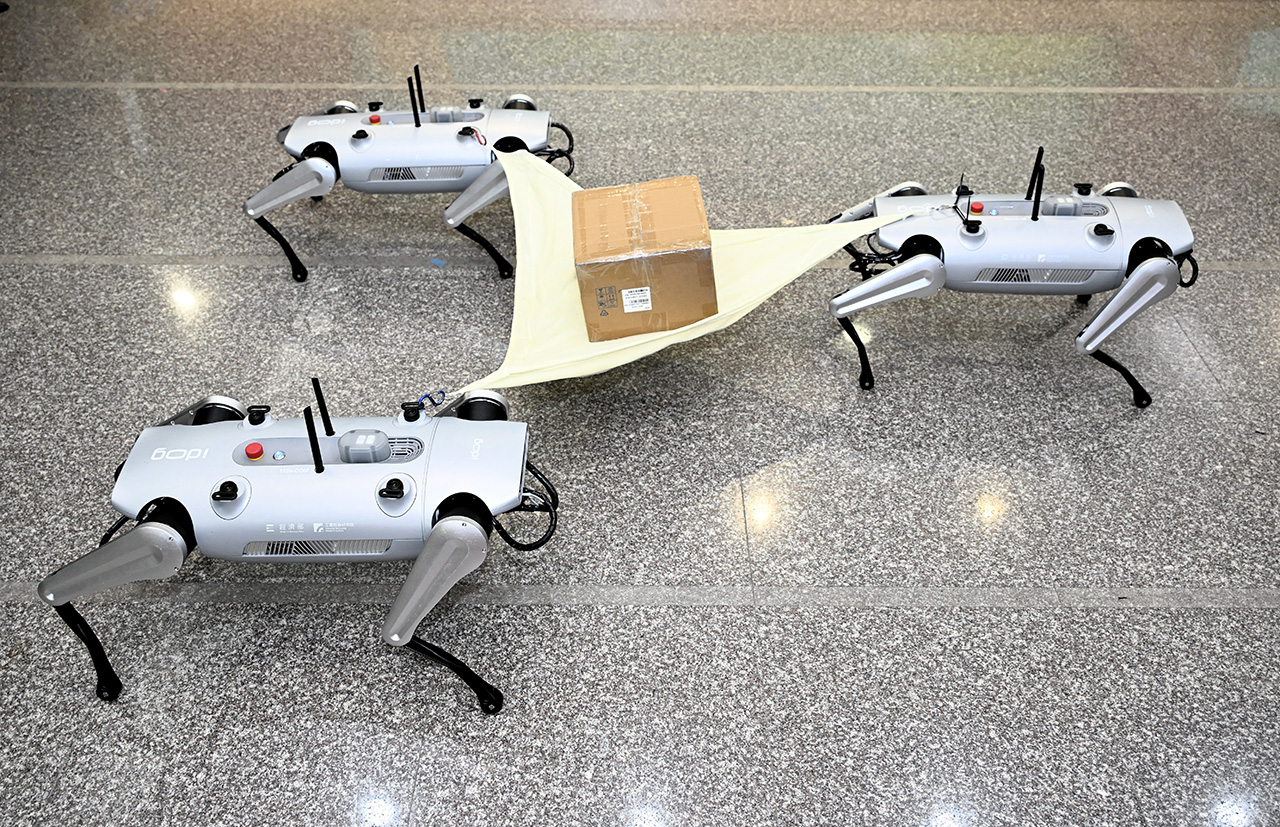
Three quadrupeds carry a box together to demonstrate multi-robot coordination during transport.
The applications may change, and so may the machines. By providing a common environment for integration and validation, the platform offers a way to test what different jobs demand—and what the next generation of robot hardware needs to deliver.