R&D Story
High Weatherability Top Coat: Thin Layer, Thick Benefits
Picture a summer afternoon in the city. The sun beats down on rooftops, air conditioners struggle to keep up, and electricity meters spin faster than ever. As urban heat intensifies, maintaining indoor comfort without overloading the grid has become one of the biggest challenges for modern buildings.
ITRI’s High Weatherability Top Coat offers a simple yet powerful answer. Designed to keep spaces cooler, more energy-efficient, and longer-lasting, this next-generation insulation coating combines materials science and sustainability in a single, protective layer.
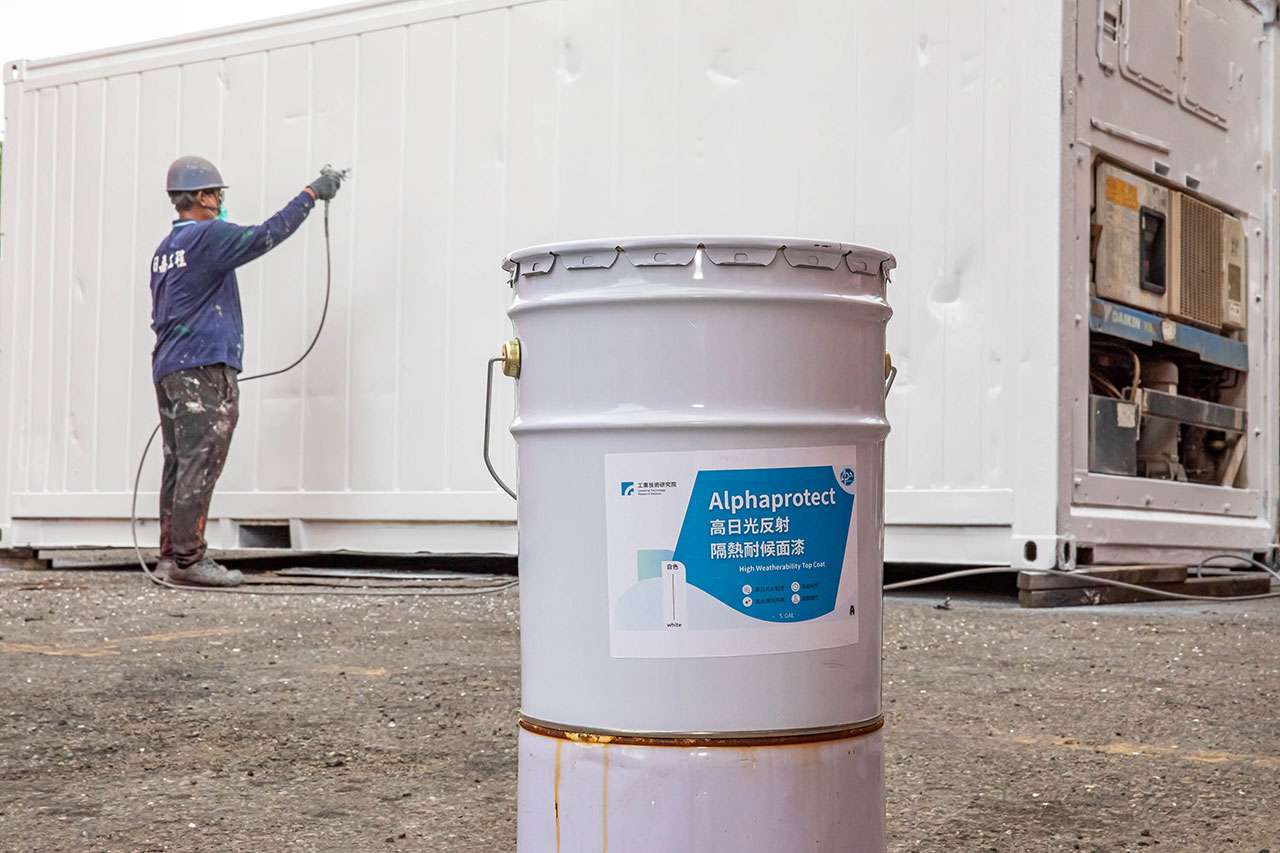
High Weatherability Top Coat in action, keeping buildings cooler while standing up to heat, humidity, and time.
Containing a patented formula, the High Weatherability Top Coat reflects up to 92% of sunlight, enhancing insulation efficiency by up to twice that of conventional coatings. In field tests, surfaces treated with the innovative coating had temperatures over 10°C lower than untreated ones. The secret lies in nanoparticle dispersion technology, which tightly packs microscopic particles on the coating’s surface to reflect light and reduce heat transfer. The result? Cooler interiors, less strain on air conditioning, and a welcome balance between comfort and energy savings.
The other star ingredient is aerogel, often dubbed the “king of insulation.” Just 1–2 millimeters of aerogel coating, featuring up to 99% porosity, delivers the same insulation performance as several centimeters of conventional coatings. It also adheres seamlessly to curved surfaces, offering both easy application and a clean, uniform finish.
“If traditional insulation materials are like a flat wall that lets heat pass through, then aerogel is like tens of thousands of tiny bubbles, forming an invisible barrier that keeps heat from spreading,” said Wei-Cheng Tang, Manager at ITRI’s Material and Chemical Research Laboratories.
Real-world applications are already proving its worth. WEITA International, a global logistics company, reported that this coating has lowered container temperatures significantly by an average of 12°C, reducing air conditioning use and improving working conditions for its logistics team. In another case, a government office building retrofitted with the coating cut its air-conditioning costs by 18%, while a badminton hall saw indoor temperatures drop by an average of 6°C, translating to about 12% annual energy savings.
The High Weatherability Top Coat is also proving valuable in industrial environments. In chemical plants, where volatile substances can evaporate under high heat, the coating applied to storage tanks helps stabilize internal temperatures, reducing material loss, air pollution, and safety risks.

The coated container (right, in yellow) maintains a surface temperature roughly 12°C lower than the uncoated one (left, in red).
Durability is another major advantage. Unlike typical coatings that start fading or chalking within one to three years, the High Weatherability Top Coat keeps performing for up to 15 to 20 years—even in harsh coastal environments like Formosa Plastics’ Mailiao facility. Its corrosion- and moisture-resistant properties make it ideal for temperature-sensitive equipment such as energy storage systems and photovoltaic (PV) inverters. It’s dirt-repellent, UV-resistant, and hydrophobic, standing firm against rain, dust, coastal wind, and relentless sunshine.
Tang added that, unlike conventional reflective coatings that rely solely on white pigment to deflect sunlight, this innovation maintains its insulation performance even when tinted in other colors. “It works just as effectively on metal roofs, concrete walls, containers, and cement surfaces,” he said. Its low-VOC formulation also minimizes odors and reduces health risks during application, making it both eco-friendly and user-friendly.
Although the initial investment is higher than that of standard coatings, Tang noted that users typically recover costs within five to eight years, thanks to 5–15% annual electricity savings and reduced maintenance.
“What we’ve developed isn’t just a product; it’s a complete energy-saving solution,” Tang said. “We handle everything from materials and process optimization to performance testing and real-world application, ensuring each step contributes to a more sustainable future.”
With proven performance and resilience, this innovation is now set to expand globally, offering its heat-resistant, long-lasting benefits to regions such as Southeast Asia and Latin America, where high temperatures and humidity challenge both comfort and energy efficiency.