R&D Focus
Building Satellite RF From Chips to Systems
Low Earth Orbit (LEO) satellites move rapidly across the sky, requiring ground terminals to continuously steer their beams to maintain reliable connections. Radio-frequency (RF) components—including beamformer, frequency up/down converters, and power and low-noise amplifiers—play crucial roles in determining whether a ground terminal with phased-array antenna can stay reliably linked to a satellite.
Taiwan’s semiconductor and ICT industries underpin much of the global electronics supply chain, yet its satellite industries have long relied on international suppliers for RF chips, the most critical component, while focusing on antenna modules and system integration. ITRI set out to build fully self-reliant capabilities in RF chips, modules, and test technologies to close this critical gap in the supply chain.
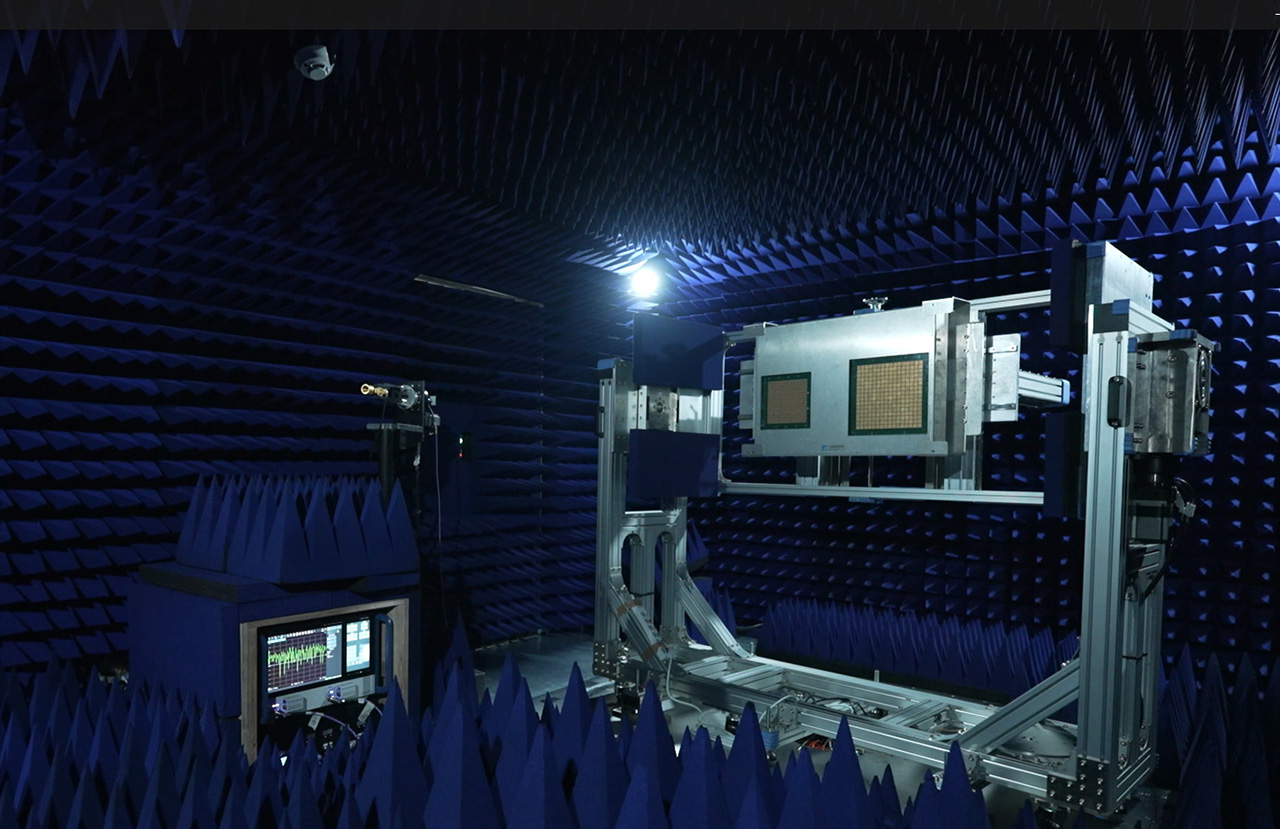
ITRI’s DFF and CATR antenna measurement systems enable real-time testing of phased-array antenna radiation performance.
Developing Core Expertise for End-to-End Solutions
Unlike terrestrial communications, where proven architectures provide a solid foundation for evolving development, satellite RF offered the team few domestic precedents to build on. ITRI focused its development on end-to-end RF components for satellite communications—spanning ground-based user terminals on one end and the satellite-side communication technologies planned by the Taiwan Space Agency (TASA) on the other. Backed by five years of experience in high-frequency 5G chips and compact space systems—and enriched by consultations with TASA and academia—ITRI successfully established a comprehensive development framework. This framework systematically integrates mission definition, link analysis, system architecture, and chip specifications.
Building on that foundation, ITRI developed an end-to-end Ka-band solution spanning RF chipsets, phased-array antenna modules, beam tracking, and testing platforms, creating a development path from component design and verification to pilot production and commercial deployment.
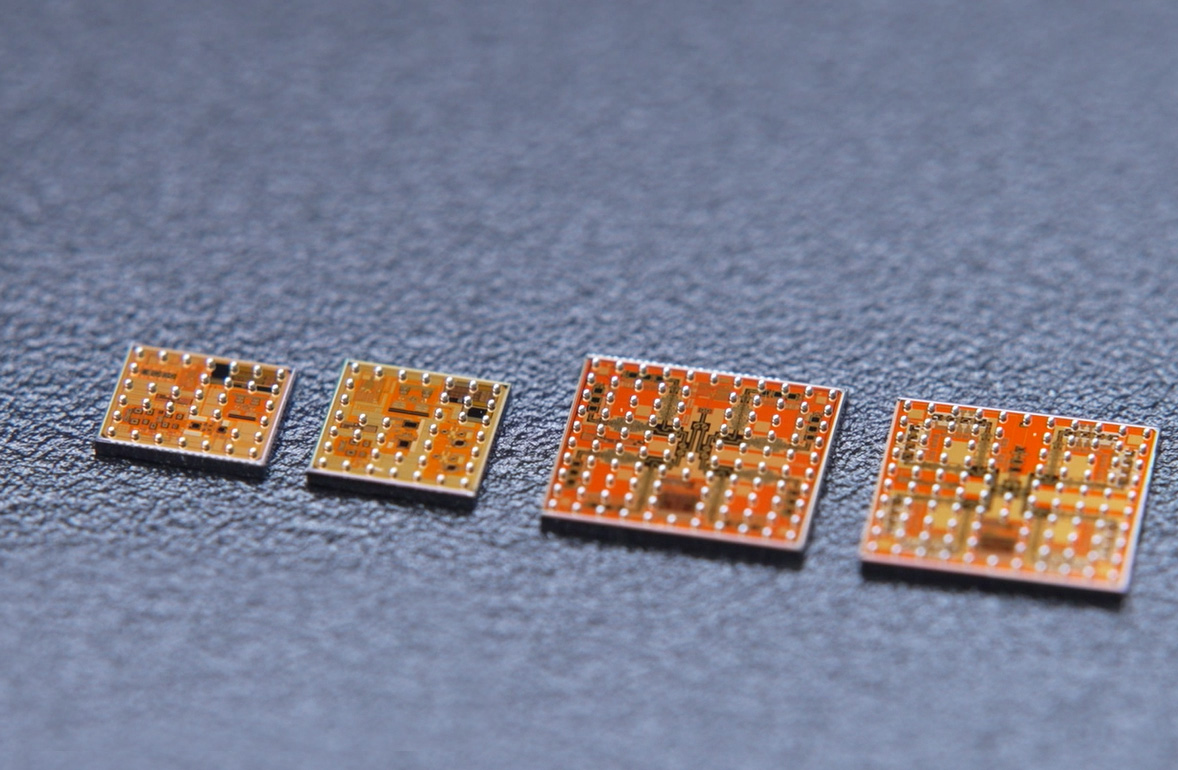
ITRI’s Ka-band solution includes RF chips, phased-array modules, beam tracking, and testing.
Tackling the Challenges of Space
Developing the chips was only part of the challenge. Satellite RF technology must maintain stable signals at millimeter-wave frequencies over long distances, while thousands of tightly packed antenna elements create challenges in power consumption, heat dissipation, and calibration. Space components must also withstand extreme temperature swings, high-energy particles, and radiation.
ITRI developed radiation-hardened IC design techniques to strengthen the reliability from circuits to systems. Its Ka-band RF solution, built with mature CMOS and GaN processes, costs only one-tenth of leading foreign alternatives after full-mask pilot production, consumes 5% to 15% less power, and stores 1,024 beam configurations for rapid switching when tracking moving satellites.
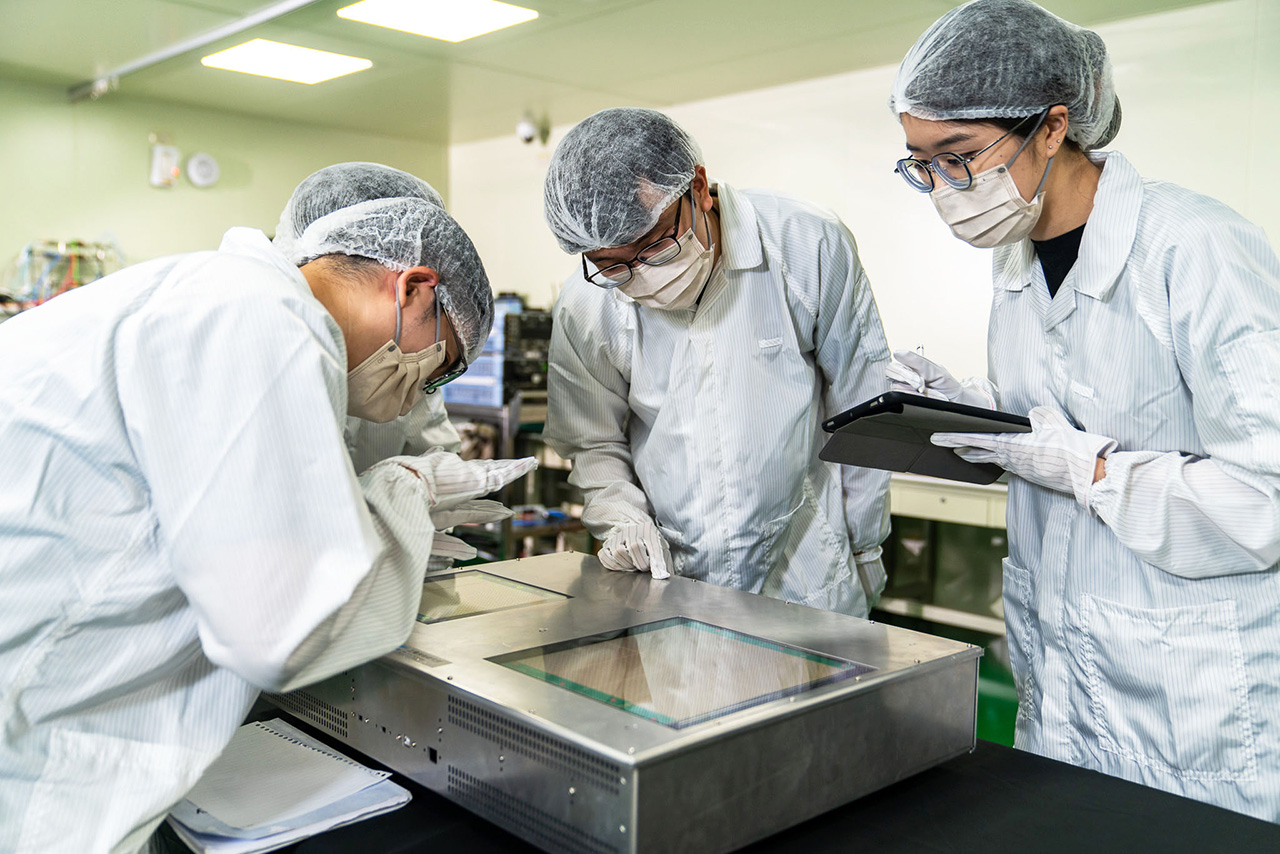
ITRI’s phased-array antenna integrates homegrown RF technologies.
Keeping the Beam Locked on Target
With the RF chips and phased-array modules in place, the next challenge was keeping antenna beams aligned with fast-moving LEO satellites. ITRI developed a hybrid beam-tracking algorithm combining open- and closed-loop techniques. Through hardware-software co-design, it continuously adjusts beam direction with millisecond-level precision to help maintain stable links.
Its phased-array ground-terminal module, which meets TASA's terminal performance specifications, achieves an EIRP of 73.5 dBm – equivalent to nearly three times the transmitted power of a leading international solution at 69 dBm, delivering better connection quality and throughput under the same conditions.
ITRI also established Taiwan’s first direct far-field (DFF) and compact antenna test range (CATR) systems, enabling phased-array antennas to be measured, calibrated, and validated locally for shortening product development cycles. Together, these capabilities provide a development environment spanning RF components, antenna integration, beam tracking, and system verification.
From R&D to Commercialization
ITRI’s technologies have helped incubate Launchip, a startup specializing in pilot chip production and cost-effective satellite ground-terminal RF solutions. By bringing together RF chip design, phased-array modules, beam tracking, testing, and pilot production, ITRI has built a comprehensive path from technology development toward commercial deployment, extending semiconductor and ICT capabilities into satellite communications.